


FICH Public Equities is a systematic, long-only investment strategy that trades exclusively within the S&P 500 universe. The algorithm evaluates relative strength every month and automatically rotates capital into the most dominant stocks, maximizing exposure to leading macro trends while completely removing human bias.
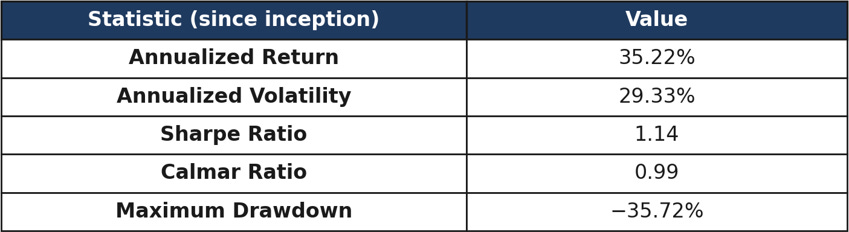
Fich Public Equities just experienced its highest drawdown since 2012, reaching 35.72% from its portfolio peak. In July, our Stocks Portfolio swung 23%, primarily driven by the sharp sell-off in semiconductor and memory stocks, bringing our year-to-date returns to 100.6%. While many see this as a cause for concern, we trust the math. Our portfolio is positioned exceptionally well for the next leg up. Embrace the opportunity while it lasts.
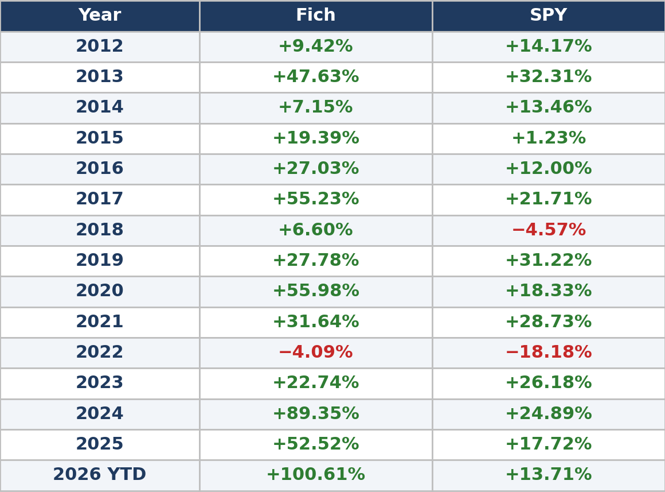
Annual Returns — Fich Strategy vs SPY
1. Macro Overview
U.S. equities were flat to slightly positive over the past 30 days into early August 2026, but performance dispersion was extreme as semiconductor and memory stocks sharply unwound from AI-driven momentum.
The equal-weighted S&P 500 significantly outperformed the Nasdaq-100 in July (equal-weighted up about 1.1% vs. QQQ down about 6.6%), reflecting rotation away from concentrated mega-cap tech leadership toward broader market participation.
The PHLX Semiconductor Index fell more than 20%, with some memory stocks down 30%+, driving much of the tech weakness.
Treasury yields rose (10-year nearing 4.7%, up roughly 20 bps over the month), signaling shifting capital dynamics.
Q2 earnings generally beat expectations across sectors (notably Information Technology, Energy, and Communication Services), but market reactions were mixed due to concerns about elevated AI-related capex.
Sector rotation favored Financials (+6.2% in July), Energy (+12.1%), Communication Services (+1.0%), Healthcare (+2.5%), Consumer Staples (+2.4%), and Real Estate (+2.4%), while Information Technology declined around 8% amid the chip-stock reversal and momentum unwind.
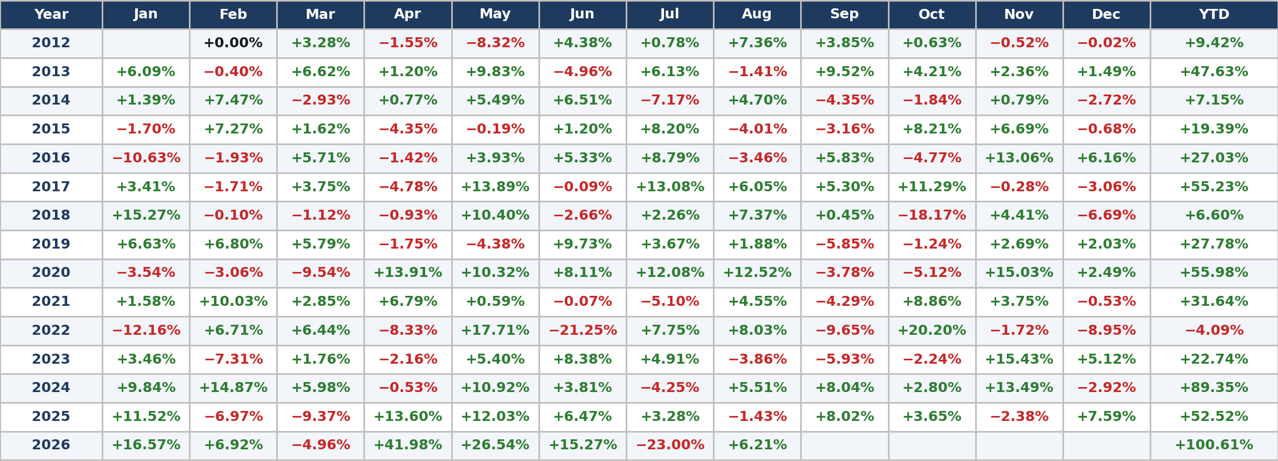
Fich Monthly Returns (2012 – present)
2. Last month overview: Fich Equities vs the market
In July 2026, Fich Equities strategy returned −23.00% in July, against +0.03% for the S&P 500.
Stepping back to the year-to-date picture:

3. The portfolio at this rebalancing: bought, sold, and held
On August 4, 2026, the system closed 1 position, opened 1 new position and held 10 from the previous months, leaving the portfolio at roughly 3.08% cash.
The algorithm systematically closes underperforming stocks while holding positions with strong momentum.
Closed trades, return on each closed position:

New position:
In August 2026, Fich Stocks Strategy allocated 3.99% of its portfolio into Dell Technologies DELL at $429 per share.
Current portfolio:
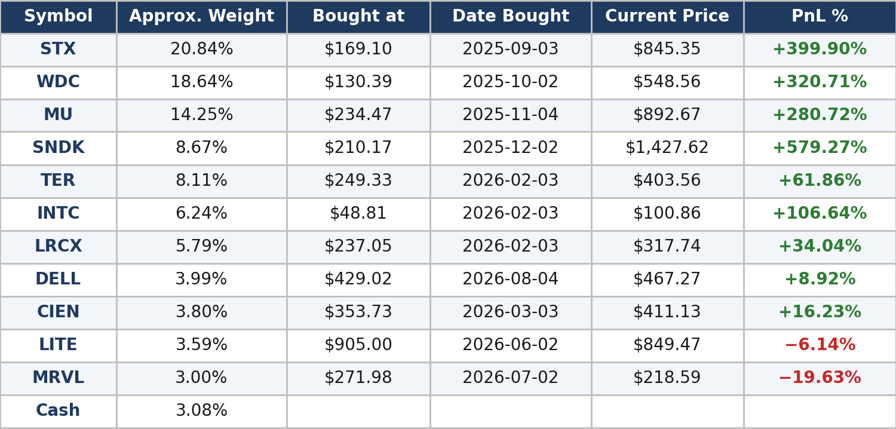
Portfolio update
STX (Seagate Technology) - Weight 20.84%. Seagate reported strong fiscal Q4 2026 results with revenue of $3.63 billion, GAAP gross margin of 52.3% (non-GAAP 52.7%), GAAP diluted EPS of $5.58, and non-GAAP EPS of $5.71. For the full fiscal year, revenue reached $12.2 billion (up 34% year-over-year), with GAAP gross margin of 45.6%, non-GAAP EPS of $15.58, record free cash flow of $3.1 billion, debt reduction of $1.4 billion, and $810 million returned to shareholders. The company highlighted robust cloud data center demand driven by AI-accelerated data generation, positioning its Mozaic platform and HAMR technology for sustained mass-capacity storage growth. Q1 2027 guidance calls for revenue of approximately $4.1 billion and non-GAAP EPS of $7.30. The stock has shown significant gains amid ongoing AI infrastructure momentum, with participation at FMS 2026 underscoring its leadership in high-capacity drives.
WDC (Western Digital) - Weight 18.64%. Western Digital is scheduled to report fiscal Q4 and full-year 2026 results on August 5, 2026, with elevated expectations tied to AI-driven enterprise storage demand. Earlier, fiscal Q2 2026 delivered revenue of $3.02 billion (up 25% year-over-year), GAAP gross margin of 45.7% (non-GAAP 46.1%), and strong free cash flow generation. Management has noted sold-out HDD capacity for 2026 under long-term agreements, supported by continued data center and high-capacity drive adoption in an AI-driven environment. Analysts anticipate robust revenue and earnings growth in the upcoming report, though some caution exists regarding post-spin visibility following the Sandisk separation. The stock has risen substantially year-to-date, reflecting optimism ahead of the print.
MU (Micron Technology) - Weight 14.25%. Micron has delivered record results fueled by AI memory demand, with fiscal Q1 2026 revenue reaching $13.64 billion and strong sequential growth continuing into subsequent quarters. The company has secured strategic customer agreements in the automotive sector and highlighted ongoing supply constraints in high-bandwidth memory, with Samsung noting prolonged shortages. Performance has been driven by execution in data center and AI applications, though the stock has experienced volatility amid broader sector rotations and high valuation expectations. Micron remains a key beneficiary of AI infrastructure buildout, with analysts projecting sustained momentum despite periodic pullbacks.
SNDK (SanDisk) - Weight 8.67%. Following its separation from Western Digital, SanDisk has seen explosive growth tied to AI storage needs, with shares up over 500% in 2026 at peaks before recent volatility. Fiscal Q3 results showed revenue nearly doubling sequentially to approximately $5.95 billion, non-GAAP gross margin expanding to 78.4%, and adjusted EPS surging to $23.41, supported by BiCS8 technology (now a significant portion of bits shipped) and data center revenue growth exceeding 200% in some periods. The company maintains a debt-free balance sheet, strong free cash flow, and a $6 billion buyback authorization, with Q4 guidance pointing to further sequential increases. Q4 earnings are due August 5, with analysts citing robust NAND pricing and AI server storage demand, though the stock has faced sharp corrections amid sector rotations.
TER (Teradyne) - Weight 8.11%. Teradyne reported record Q2 2026 revenue of $1.33 billion (up over 100% year-over-year) and non-GAAP EPS of $2.47, significantly beating estimates, driven primarily by AI-related semiconductor test demand. The company has delivered consecutive quarters of record performance, with strong margins and upbeat guidance for Q3 (revenue $1.2–1.3 billion). Management highlighted AI as the key driver, with analysts raising price targets in response to execution and visibility in test equipment for advanced chips. Robotics and system test segments provide additional diversification, though near-term focus remains on semiconductor test strength amid the AI cycle.
INTC (Intel) - Weight 6.24%. Intel reported Q2 2026 revenue of $16.1 billion (up 25% year-over-year) amid ongoing recovery efforts in its foundry and product businesses. The company continues to advance its AI PC and packaging initiatives, including collaborations for on-device Agentic AI, while facing competitive pressures in AI accelerators. Recent news includes overtime incentives at its Ohio facilities and mixed analyst views on server and foundry outlook. The stock has shown volatility but responded positively to certain product pricing actions and yield improvements. Intel’s turnaround narrative centers on regaining share in data center and foundry amid broader AI infrastructure demand.
LRCX (Lam Research) - Weight 5.79%. Lam Research posted record fiscal Q4 2026 results with revenue of $6.72 billion (up 30% year-over-year), non-GAAP gross margin of 52.0%, operating margin of 38.4%, and EPS of $1.82, exceeding estimates. The company raised guidance for the next period to approximately $8.1 billion in revenue, reflecting robust AI-driven wafer fabrication equipment demand and the highest gross margins in two decades. Systems and customer support revenue grew strongly, with management citing sustained semiconductor spending tied to AI. The stock rallied on the beat-and-raise, reinforcing Lam’s position as a leading indicator for AI infrastructure capital expenditures.
DELL (Dell Technologies) - Weight 3.99%. Dell continued its AI server momentum in 2026, highlighted by Dell Technologies World where it announced the next-generation AI Factory with NVIDIA, reaching 5,000 customers for on-premises AI solutions. The company has built a substantial AI server backlog, supported by earlier workforce optimization (approximately 11,000 positions reduced in fiscal 2026 to fund growth initiatives). Focus remains on enterprise AI infrastructure, data foundations, and partner enablement, with events underscoring leadership in scaled AI deployments and disaggregated inference. Dell is well-positioned in the hybrid AI market, balancing hardware innovation with services.
CIEN (Ciena) - Weight 3.80%. Ciena has benefited from AI-related optical networking capital expenditures, reporting a record backlog and expectations of triple-digit EPS growth in 2026. The company strengthened its leadership in AI networking with expertise showcased at industry events and key executive appointments. Analysts view shares as attractive on cash flow metrics despite premium valuations, with moderate buy consensus. Ciena’s optical infrastructure solutions are increasingly critical for high-speed, low-latency AI data center interconnects, supporting durable demand in the networking layer of AI buildout.
LITE (Lumentum) - Weight 3.59%. Lumentum has experienced dramatic gains, with the stock up over 1,000% in the past year, driven by its strategic partnership with NVIDIA (including a multi-billion-dollar investment and purchase commitments for lasers and optical components). Demand for its photonic and optical solutions in AI infrastructure has propelled strong growth projections, with fiscal Q2 2026 earnings (due August 11) expected to show over 100% revenue growth and nearly 240% EPS increase. The company continues to expand capacity and secure design wins, solidifying its role in high-speed optics for AI networking and data centers. It was added to the S&P 500 amid the rally.
MRVL (Marvell Technology) - Weight 3.00%. Marvell advanced its AI memory infrastructure portfolio in early August 2026 with new Bravera SSD controllers, Structera X CXL memory expansion, and Photonic Fabric for optical shared memory, targeting agentic AI inference challenges such as KV cache growth and token efficiency. The company will showcase these solutions at FMS 2026 and announced a $250 million investment in India. It also scheduled its Q2 FY2027 earnings call and an Investor Day for October. These innovations position Marvell to address rack-scale and pod-level memory needs in AI servers, supporting higher throughput within existing power and space constraints. The stock reacted positively to the AI-focused announcements.
4. Multi-year track record
As of yesterday, that hypothetical $1,000 was worth $77,738.18 in the strategy, versus $7,792.74 in S&P 500.
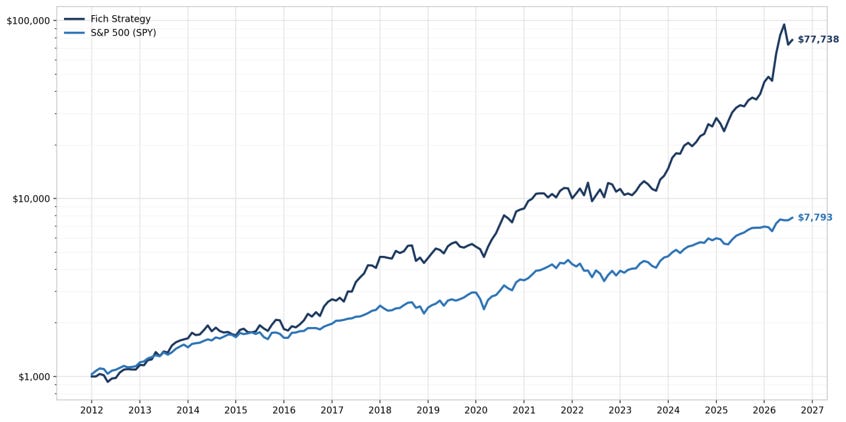
Fich Equities Strategy vs. SPY - growth of $1,000 since inception (log scale).
Disclaimer: Past performance is not indicative of future results. All strategy performance metrics and stated returns are net of a 0.10% commission fee per trade. This letter is for informational purposes only and does not constitute investment advice. For comprehensive historical data and complete execution logs, visit fich.ai.